How to set a meaningful goal: a worked example
By Moderion ·
Turn a vague wish into a meaningful goal with a realistic first action. Follow a friendship example, then try the same questions yourself.
Start with the change you want and why it matters to you. Then choose a realistic action you can take and a moment to review it. A useful goal gives you direction without pretending you can control every result.
Goal setting can help people change behaviour, although the average benefit in a large research review was modest. [1] The aim is to make a goal useful in your life, rather than find a perfect sentence.
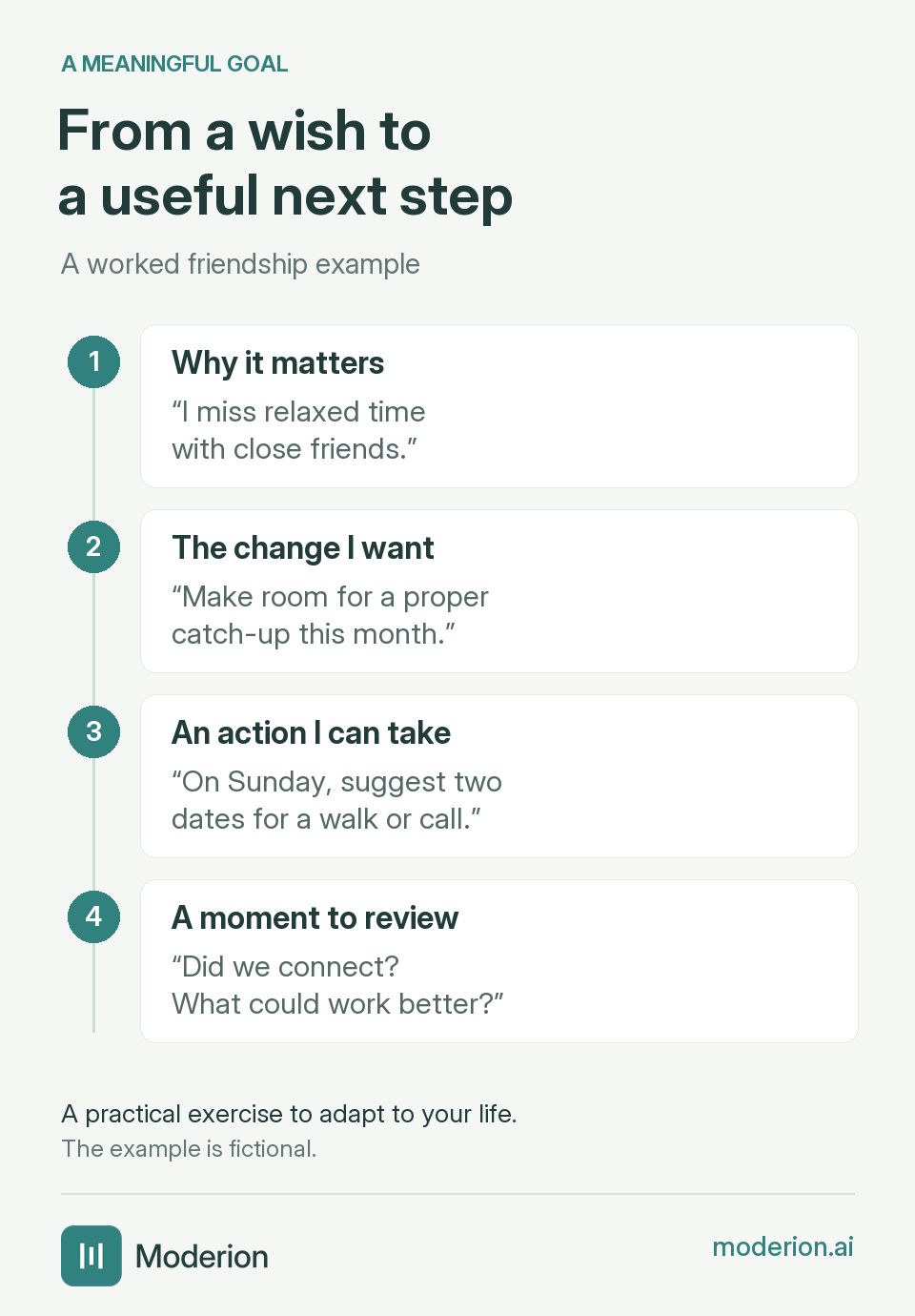
Here is a fictional example: “I want to be closer to my friends.”
1. Explain why it matters
Ask what you miss or would like more of. “I should socialise more” might become “I miss relaxed conversations with two close friends.”
That reason helps you judge the plan later. A full social calendar would not necessarily give you the connection you want.
A 2025 research review linked goals that people personally value or enjoy with greater effort and progress. Most of the evidence was observational, so it cannot prove that changing your reason will change your result. [2]
2. Describe the change and check what fits
“Be a better friend” leaves a lot unanswered. Try describing something you would like to happen: “Over the next month, I want to make room for an unhurried catch-up.”
Check the fit with real commitments. A walk might suit nearby friends. A call might work better across countries. This fictional person's monthly plan is an example, not a recommended friendship quota.
Clear targets can help task performance, but clarity alone is not enough. Skills, commitment, feedback and the difficulty of the task also matter. Much of that research concerns work and laboratory tasks, so it cannot directly establish what improves a friendship. [3]
3. Choose an action you can influence
You can send an invitation, suggest times and make room to listen. You cannot require someone to accept or guarantee that they feel closer.
Choose a first action: “After Sunday breakfast, I will message them and suggest two dates for a walk or call.”
The action supports the goal. It is not the whole goal. Counting messages would tell you what you did, but not whether you had the connection you wanted.
You now have a clearer plan: “I want more relaxed time with two close friends. This month, I will invite them for a walk or call, starting with a message on Sunday.”
4. Decide what you will review
Choose a return point that fits your situation. At month-end, this person could ask:
- Did we get time together?
- Was it the kind of connection I wanted?
- What could make the next invitation work better?
If the dates did not work, another time or format may help. You can change the plan while keeping the reason that matters.
For an unfamiliar goal, the first step may be learning rather than reaching a result. If you are considering a career change, a conversation with someone in the field or a small sample project could help you understand the work before setting an application target. Complex-task research supports this distinction, with limits. [3]
Try it with your own goal
The sequence here is a practical exercise, not a tested programme. Try it with one goal:
- This matters to me because…
- The change I want to notice is…
- A realistic action I can take is…
- I will return to it when…
Sources
- [1]Unique effects of setting goals on behavior change: Systematic review and meta-analysis · Epton, Currie and Armitage; Journal of Consulting and Clinical Psychology
- [2]Goal Motives, Approach/Avoidance Appraisals, Psychological Needs, and Well-Being: A Systematic Review and Meta-Analysis · Sezer and colleagues; Motivation Science
- [3]Building a Practically Useful Theory of Goal Setting and Task Motivation: A 35-Year Odyssey · Locke and Latham; American Psychologist